Proper sign height isn't just about making sure drivers can read the message; it's a strict MUTCD compliance issue designed to maintain sightlines, protect pedestrians, and ensure the sign itself survives the work zone.
Mounting a temporary traffic control (TTC) sign at the wrong elevation can lead to blocked visibility from parked cars, or worse, create a hazardous obstacle for pedestrians.
Portable Sign Stands: The 1-Foot Minimum
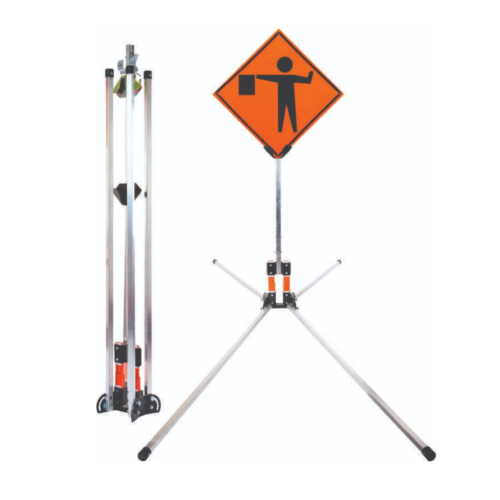
For short-term, temporary work zones, road crews rely heavily on portable sign stands rather than driving posts into the ground.
- The Standard: According to the MUTCD, signs mounted on portable supports must be a minimum of 1 foot (12 inches) from the bottom of the sign panel to the elevation of the near edge of the pavement.
- Application: This applies to standard roll-up and rigid signs deployed for daily operations. Keeping the sign lower to the ground reduces the wind load on the stand's springs and base.
Rural Environments: The 5-Foot Rule
When temporary signs are mounted on more permanent supports in rural areas, the elevation requirements change significantly to account for roadside vegetation and high-speed visibility.
- The Standard: The minimum height is 5 feet, measured from the bottom of the sign to the near edge of the pavement.
- Clearance: This height ensures that the sign remains visible over tall grass, standard roadside guardrails, and slight dips in the shoulder, giving high-speed drivers ample reaction time.
Urban and Pedestrian Areas: The 7-Foot Rule
In business districts, residential neighborhoods, or any area with foot traffic, a low-mounted sign becomes an immediate hazard.
- The Standard: In urban areas, the sign must be mounted at a minimum height of 7 feet from the bottom of the sign to the top of the curb or pedestrian surface.
- Safety First: This clearance is crucial. It ensures pedestrians can safely walk underneath the sign without hitting their heads, and it keeps the sign visible to approaching traffic over the roofs of parked vehicles.
Stability at Higher Elevations
Raising a sign panel to 5 or 7 feet dramatically increases its center of gravity and the wind resistance it generates. Because of this, standard lightweight portable stands cannot be used for high-elevation mounting.
- Heavy-Duty Bracketry: When elevating signs, the hardware takes on immense torsion. Whether the components are sourced globally or manufactured domestically, the brackets and joints connecting the mast to the base must be constructed of resilient materials like zinc-plated steel or aluminum rather than brittle iron that can degrade.
- Rigid Masts: Ensure you are using MASH-2016 compliant rigid sign stands or post-driven systems specifically rated to hold heavy sign blanks at a 7-foot height without tipping over in heavy gusts.
For more guides on traffic safety equipment, regulatory compliance, and field maintenance, return to the Eastern Metal Knowledge Center.
-
 Apex Sign Stands, Full-Size Sign Stands For Temporary Traffic Control
Apex Summit Full Size Sign Stand Dual Leaf Spring MASH Approved wz-450
Price range: $370.11 through $420.36Select options This product has multiple variants. The options may be chosen on the product pageQuick View -
 Apex Sign Stands, Mid-Size Sign Stands, Sign Stands, Sign Stands, XPress Program
Apex Dual Recoil Mid-Size Traffic Sign Stands
Price range: $270.24 through $289.41Select options This product has multiple variants. The options may be chosen on the product pageQuick View -