
STOP/SLOW Paddles & Traffic Flagger Control Equipment
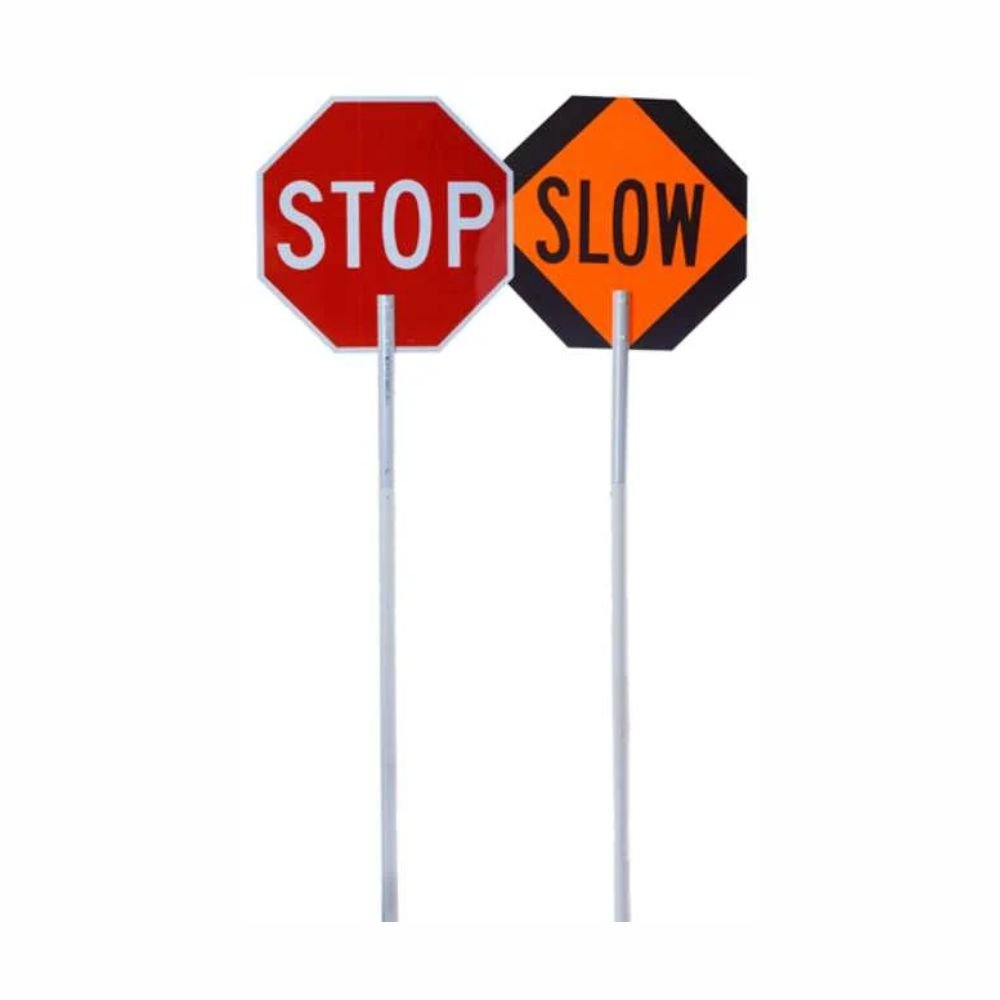
STOP/SLOW paddles are the primary, preferred hand-signaling devices used by flaggers to safely guide road users through temporary traffic control (TTC) zones. Engineered to federal safety standards, these traffic control devices provide positive, unambiguous guidance to oncoming motorists, significantly reducing work zone accidents.
Compliance with the Federal Highway Administration's (FHWA) Manual on Uniform Traffic Control Devices (MUTCD) is a strict legal requirement for work zone operations. The 11th Edition (2023) outlines specific mandates under Chapter 6E.03: Hand-Signaling Devices.
MUTCD Compliance Guide for Traffic Paddles
- Primary Device: The STOP/SLOW paddle shall be the primary signaling device; flags are restricted solely to emergency situations.
- Shape: Must feature a rigid, octagonal shape.
- Dimensions: Minimum width of 18 inches (450 mm). For high-speed roadways (≥ 30 mph) or high-volume intersections, the MUTCD strongly recommends a 24-inch (600 mm) paddle.
- Lettering Height: Upper-case letters must be at least 6 inches (150 mm) high. 24-inch paddles should utilize 8-inch lettering to maximize driver braking distance.
- Color Profile:
- STOP Face: Red background with a white border and white lettering (matching standard R1-1 regulatory sign geometry).
- SLOW Face: Orange background with a black border and black lettering (matching W20-8 warning sign geometry).
- Nighttime Operations: Any paddle deployed after sunset must be fully retroreflectorized.
Engineering and Materials
A traffic control paddle must balance durability in harsh conditions against ergonomic constraints. Flaggers hold these signs for extended shifts, making substrate engineering critical.
- Aluminum Substrates: Professional-grade paddles are typically forged from .063-gauge tarnish-free aluminum. Aluminum offers superior rigidity against wind loading and high impact resistance, but represents the heaviest option.
- ABS Plastic & Polycarbonate: Polymeric substrates (typically .125" thick) offer excellent UV resistance and are shatterproof. ABS provides a lighter alternative while remaining rigid under moderate wind shear.
- Corrugated Plastic: Ultra-lightweight, corrugated materials drastically reduce flagger fatigue. However, they lack long-term weather resistance, making them suitable only for short-duration deployments.
Reflective Materials for STOP/SLOW Signs
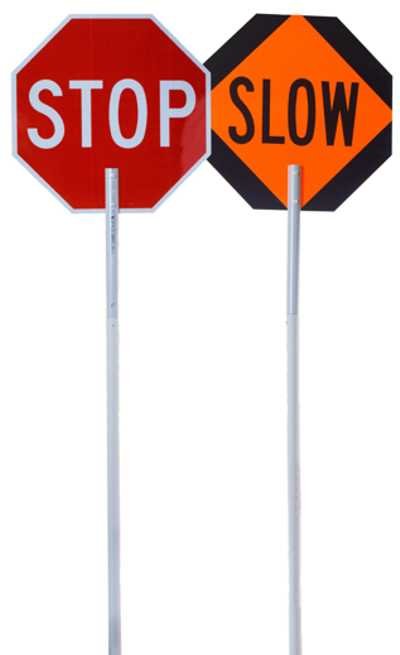
To comply with MUTCD retroreflectivity mandates, paddles are wrapped in engineered micro-prismatic sheeting.
- Engineer Grade (Type I): Uses basic glass-bead technology. Suitable primarily for low-speed, bright ambient light urban corridors.
- High Intensity Prismatic (HIP - Type IV): The preferred baseline for commercial highway work zones. HIP bounces light efficiently through wide angles, cutting through peripheral industrial dust and heavy atmospheric mist.
- Diamond Grade (Type XI): The premium standard. Delivers maximum visibility for complex, high-speed, or multi-lane intersections where extreme light return is vital.
Flagging Staff Options
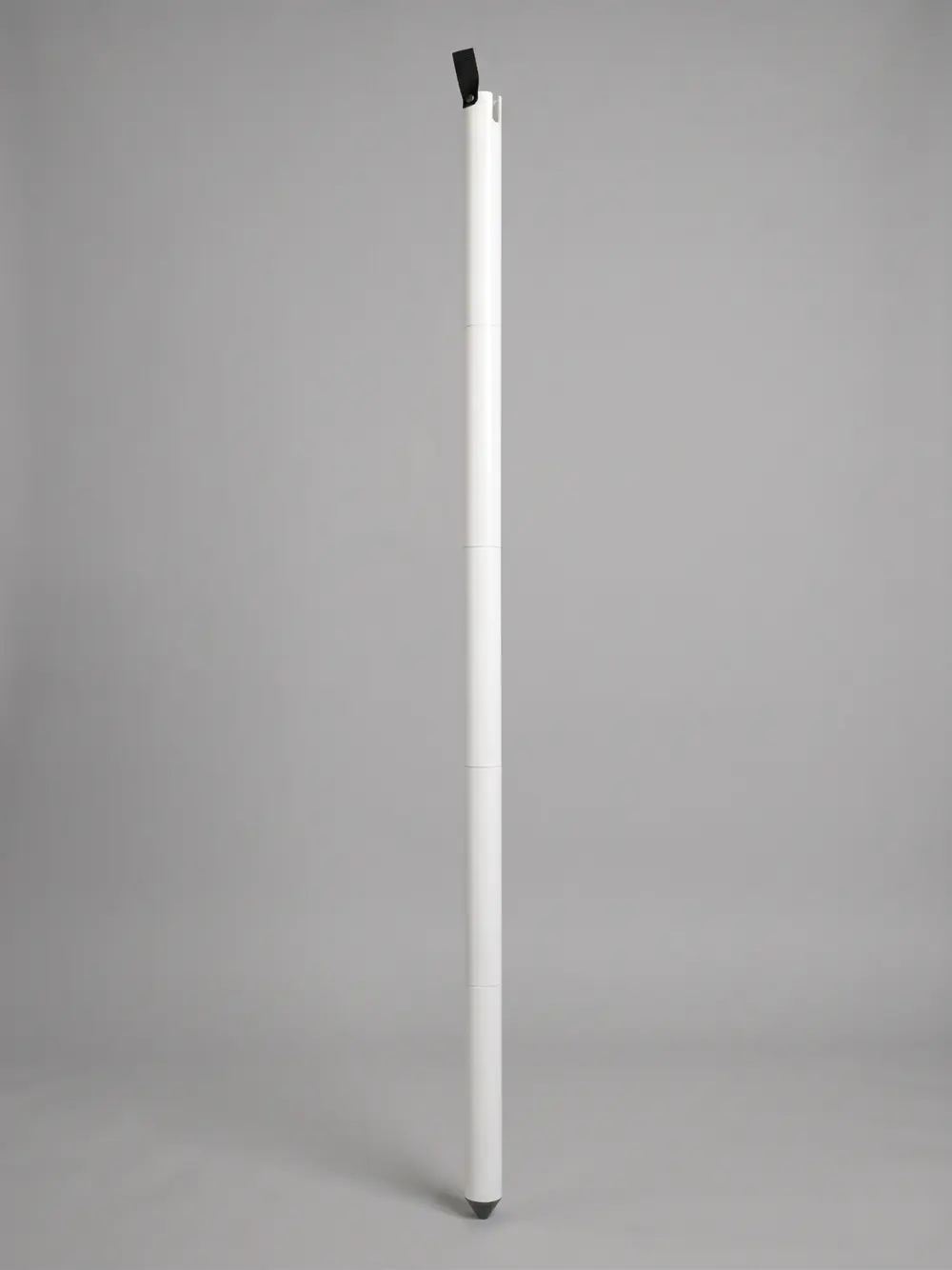
Holding a paddle directly by a short handle causes rapid fatigue and often violates height requirements during stationary operations.
- MUTCD Height Mandate: When a staff rests firmly on the pavement, the lowest edge of the sign body must be a minimum of 6 feet (72 inches) above the ground.
- Fiberglass Staffs: The industry standard. Fiberglass is non-conductive (critical for utility line crews), lightweight, and highly durable against impact.
- Aluminum Staffs: Offers maximum rigidity but can be highly conductive around power lines.
Material Comparison Table
| Material | Weight (18" Face) | Weather/Wind Resistance | Expected Lifespan | Professional Use Suitability |
|---|---|---|---|---|
| .063 Aluminum | Heavy (~3.15 lbs) | Exceptional / Will not bend | 5+ Years | Highway / DOT approved |
| .125 ABS Plastic | Moderate (~3.0 lbs) | High / Rigid | 3-5 Years | Standard Work Zones |
| Polycarbonate | Moderate (~2.8 lbs) | High / Impact Resistant | 3-5 Years | Standard Work Zones |
| 4mm Corrugated | Very Light (~1.4 lbs) | Low / Prone to bending | < 1 Year | Emergency / Short Duration |
Ready to Equip Your Crew?
Browse our full inventory of MUTCD-compliant paddles, fiberglass staffs, and traffic control accessories.
Shop STOP/SLOW Paddles NowFrequently Asked Questions
What size STOP/SLOW paddle is MUTCD compliant?
The baseline federal standard is an 18-inch wide octagon with 6-inch tall upper-case letters. However, on high-speed roads (over 30 mph), a 24-inch wide paddle with 8-inch lettering is recommended, and often mandated by regional jurisdictions.
Are STOP/SLOW paddles required for flaggers?
Yes. Under MUTCD Section 6E.03, the STOP/SLOW paddle is the primary and preferred hand-signaling device for temporary traffic control because it provides road users with positive guidance.
What material is best for a STOP/SLOW paddle?
For long-term highway construction, .063-gauge tarnish-free aluminum or .125-inch high-impact ABS plastic is preferred due to wind-load rigidity and heavy-duty durability.
What reflective material is used on STOP/SLOW signs?
Professional signs utilize Type IV High-Intensity Prismatic (HIP) or Type XI Diamond Grade retroreflective sheeting, ensuring the paddle effectively bounces ambient headlight illumination back to drivers at night.
Why Choose Eastern Metal Signs & Safety
As a trusted manufacturer based in Elmira, New York, Eastern Metal Signs & Safety (USA-Sign) engineers traffic control devices that exceed baseline federal MUTCD and state DOT requirements. Our STOP/SLOW paddles are precision-manufactured in-house, layered with verified premium retroreflective sheeting, and rigorously tested for impact resistance and wind loading.
Whether you need heavy-duty aluminum paddles for high-speed highway zones or lightweight ABS for long-duration stationary flagging, our fabrication team ensures every unit delivers uncompromising visibility. Shop our full selection or contact our team today to outfit your fleet with American-made tools that bring your crews home safely.
