At Eastern Metal Signs and Safety, we’ve been engineering and supplying work zone safety equipment since 1947. Over our decades in the traffic control industry, one of the most frequent questions our technical team fields from contractors, DOTs, and municipalities revolves around compliance with the MUTCD (Manual on Uniform Traffic Control Devices).
When it comes to road closures and high-speed work zones, Type III (Type 3) barricades are your primary line of defense. Below is our expert guide to what they are, how the MUTCD regulates them, and when you are legally required to deploy them.
Need MUTCD-Compliant Type III Barricades Now?
Browse our selection of durable, crash-tested Type III barricades manufactured for immediate job site deployment.
-
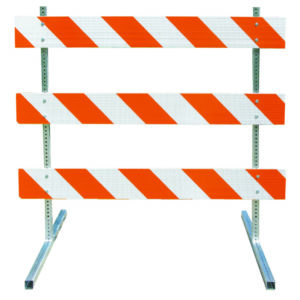 Barricades, Incident Managment, Type III Barricades
Type III Barricades from Eastern Metal
Select options This product has multiple variants. The options may be chosen on the product pageQuick View
The Backbone of Traffic Safety: What is the MUTCD?
The MUTCD is the national standard governing all traffic control devices—including signs, signals, pavement markings, and barricades—installed on any street, highway, pedestrian facility, or bikeway in the United States. Published by the Federal Highway Administration (FHWA), the manual ensures strict visual uniformity across the country.
Why it matters: If a piece of traffic control equipment is not MUTCD-compliant, it cannot be legally or safely used on public roadways. This uniformity guarantees that a driver from New York instantly recognizes a road closure warning in California, reducing reaction time and preventing accidents.
What Exactly is a Type 3 Barricade?
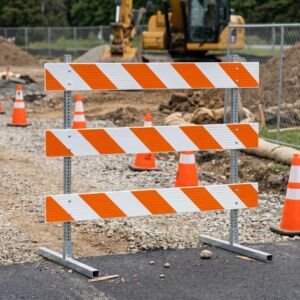
A Type III barricade is the largest, most visible class of traffic barricade. It is visually defined by having three horizontal reflective rails and is engineered specifically to signal a complete road closure, a major detour, or a highly restricted access point.
Because they are deployed in the most critical traffic control scenarios—often on highways or high-speed roads—the MUTCD mandates strict physical dimensions and optical properties to ensure they are visible day and night, from significant distances.
MUTCD Baseline Specifications for Type III Barricades
To pass inspection and meet legal standards, a Type III barricade must adhere to the following:
- Minimum Height: The top of the uppermost rail must be at least 60 inches (5 feet) from the ground.
- Rail Dimensions: Each of the three rails must be 8 to 12 inches high and a minimum of 48 inches (4 feet) wide. (They can extend up to 12 feet wide for massive closures).
- Reflective Striping: Rails must feature alternating orange and white retroreflective stripes.
- Stripe Width: Stripes must be exactly 6 inches wide.
- Stripe Angle: Stripes must slope downward at a strict 45-degree angle.
Decoding the Stripes: A Critical Safety Feature
The angled stripes on a Type III barricade aren't just for visibility; they are directional cues. Installing them backward is a common, yet highly dangerous, job site mistake. The MUTCD states that the stripes must slope downward in the direction traffic is supposed to pass.
Stripes sloping downward to the left mean traffic must pass to the left of the barricade.
Stripes sloping downward to the right mean traffic must pass to the right.
Stripes sloping inward toward the center mean the road is entirely closed. Traffic must stop.
Pro Tip: If you are using a double-sided barricade, ensure the pattern mirrors correctly on the back so traffic approaching from the opposite direction receives the accurate passing instruction.
Barricade Class Comparison
Understanding when to step up to a Type III barricade is easier when you compare it to the smaller classes used for pedestrian or low-speed urban routing.
| Feature | Type I | Type II | Type III |
|---|---|---|---|
| Reflective Rails | 1 rail (top only) | 2 rails | 3 rails |
| Minimum Height | 36 inches | 36 inches | 60 inches (5 ft) |
| Minimum Width | 24 inches | 24 inches | 48 inches (4 ft) |
| Primary Application | Pedestrian paths, low-speed | Urban streets, lane shifts | Highway closures, detours |
The Eastern Metal Standard: MASH Compliance
MUTCD compliance is the baseline, but physical durability and crash safety dictate the true quality of your equipment. Modern Type III barricades used on public projects must also meet MASH (Manual for Assessing Safety Hardware) crash test standards.
At Eastern Metal Signs and Safety, our Type III boards are manufactured from high-density polyethylene (HDPE). This material resists fading, chipping, and splintering in brutal weather conditions. More importantly, it is engineered as a lightweight, fracturable material. If a vehicle impacts the barricade at high speeds, the structure yields safely—preventing heavy debris from penetrating the vehicle's cabin while still securely holding mandatory "ROAD CLOSED" signs and flashing barricade lights.
Don't compromise on safety or compliance. Equip your next work zone with Eastern Metal Type III Barricades today.