Expert Answers to Your Traffic Safety Questions
Navigating MUTCD guidelines, state-specific DOT requirements, and MASH crash-test standards can be complex. When lives are on the line, there is no room for guesswork. Below, our experts at Eastern Metal Signs & Safety have compiled answers to the most critical questions we receive from contractors and municipalities about selecting and deploying temporary traffic safety products.
When evaluating crash-tested highway safety hardware, the critical difference between MASH (Manual for Assessing Safety Hardware) and the older NCHRP-350 standard comes down to modern vehicle realism. NCHRP-350 was published in 1993, a time when lighter passenger cars dominated the roads. As SUVs and heavier pickup trucks became the standard, the Federal Highway Administration (FHWA) recognized that safety hardware needed to withstand much greater force.
MASH was introduced to replace NCHRP-350 by testing devices against today’s larger, heavier vehicle fleet. For example, the standard light truck test vehicle increased from 4,400 lbs under NCHRP-350 to a 5,000 lb pickup truck under MASH. Furthermore, impact angles were steepened from 20 degrees to 25 degrees, simulating more severe, real-world crash conditions.
If you are deploying new sign stands on the National Highway System (NHS) or federally funded projects, MASH compliance is now the mandatory benchmark. While previously accepted NCHRP-350 devices may be grandfathered in for their useful service life, any new temporary traffic control devices manufactured and deployed today must pass these stricter MASH testing protocols to ensure ultimate worker and motorist safety in the work zone.
Selecting the right roll-up sign material is entirely dependent on when your work zone is active. For nighttime operations, standard non-reflective vinyl or mesh materials are strictly prohibited by the Manual on Uniform Traffic Control Devices (MUTCD). Nighttime visibility requires highly retroreflective materials to ensure drivers have adequate reaction time.
To maintain compliance and maximum safety after dark, you must choose either High-Intensity Prismatic (HIP) or Diamond Grade (microprismatic) reflective materials. High-Intensity Prismatic signs utilize advanced micro-prism technology that reflects a significantly higher percentage of light back to the source compared to older engineering-grade sheeting. This makes them ideal for standard nighttime lane closures and municipal work.
For high-speed interstates and complex highway work zones, Diamond Grade or equivalent top-tier microprismatic sheeting is heavily recommended. These premium materials provide unparalleled luminance at wider angles, ensuring the sign is intensely visible even to drivers in peripheral lanes or large commercial trucks. Always verify your specific state DOT guidelines, as many mandate specific grades of prismatic sheeting for nighttime operations.
Wind gusts are one of the most common hazards for temporary traffic control setups. Using standard, rigid sign stands in high-wind environments often leads to two dangerous outcomes: the stand acts like a sail and tips over, or the wind forces the base to "walk" directly into the path of live traffic.
Spring-loaded sign stands are specifically engineered to neutralize these risks. By integrating heavy-duty automotive-grade dual springs into the base, the vertical mast is allowed to flex and yield when hit by a strong gust. As the wind catches the roll-up sign, the springs absorb the kinetic energy, transferring it away from the legs. This deflection keeps the center of gravity low and prevents the stand from lifting or skidding.
The hardware construction of the stand is equally important to its wind resistance. Our brackets and moving components on high-quality stands are crafted from zinc-plated steel or lightweight aircraft-grade aluminum—never brittle materials that can crack under stress. For wide-open highways or overpasses where crosswinds are severe, combining a dual-spring stand with a stable, wide-footprint leg deployment is the safest way to ensure your warnings stay upright.
The MUTCD has exact, non-negotiable requirements for traffic cone height and retroreflectivity based on the speed of the roadway and the time of day. Using the wrong size cone can lead to severe liability and compromised work zone safety.
For daytime operations on low-speed local streets (40 mph or less), the MUTCD allows for standard 18-inch orange traffic cones. However, the moment your project moves to a roadway with speeds of 45 mph or higher—or if your work extends into the nighttime—you must upgrade to a minimum cone height of 28 inches. For urban freeways and high-volume interstates, 36-inch cones are heavily recommended and often required by state-specific DOTs.
During nighttime deployments, height alone is not enough; retroreflectivity is legally mandated. Any 28-inch to 36-inch cone used at night must feature two high-intensity white reflective collars. The top collar must be exactly 6 inches wide and placed 3 to 4 inches from the top of the cone. The bottom collar must be 4 inches wide and spaced 2 inches below the top band. Maintaining these exact dimensions ensures uniform light reflection.
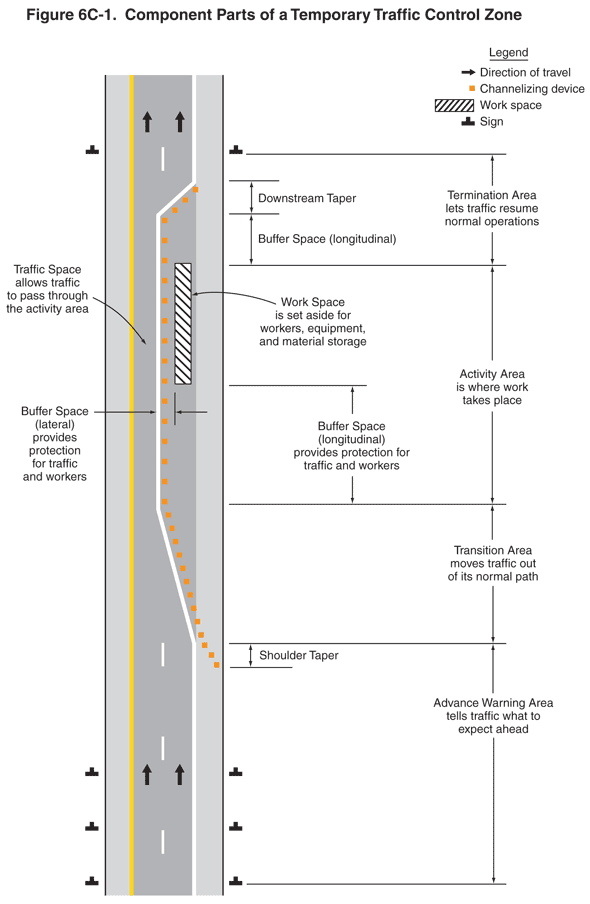
The advanced warning area is the first point of communication with a driver, and setting it up correctly is the foundation of a safe temporary traffic control zone. According to MUTCD guidelines, this area must give drivers enough time to perceive the upcoming hazard, process the information, and safely adjust their speed and lane position well before reaching the actual transition area.
The deployment relies on an A, B, and C spacing sequence for your warning signs (typically "Road Work Ahead," "Right Lane Closed Ahead," and a final symbol or flagger sign). The exact distance between these signs depends heavily on the road type. In urban, low-speed environments, signs should be spaced 100 to 500 feet apart. On rural, moderate-speed highways, increase that spacing to 500 to 1,500 feet. On high-speed expressways and freeways, drivers need massive reaction windows, requiring signs to be spaced 1,000 to 2,600 feet apart.
You should always deploy your advanced warning signs in a specific order: starting with the sign furthest away from the work zone and working your way inward toward the taper. This ensures that you are protected by your own warning signs as you continue to set up the rest of the traffic control zone.